Market growth and digital adoption
The bridge monitoring system market is entering a phase of accelerated valuation, driven by the convergence of aging infrastructure and advanced data analytics. Global projections place the market size at $1.4 billion in 2026, with an anticipated rise to $3.1 billion by 2033 [src-serp-3]. This expansion reflects a 9.9% compound annual growth rate, signaling a structural shift from reactive maintenance to predictive, data-driven asset management [src-serp-7].
Digital twins are the financial engine behind this growth. By 2026, approximately 15% of newly instrumented bridges globally will incorporate digital twin frameworks, a figure expected to surpass 45% by 2034 [src-serp-8]. These virtual replicas allow agencies to simulate stress, predict failure points, and optimize repair schedules before physical degradation becomes critical. The technology transforms bridge monitoring from a cost center into a strategic investment in longevity and safety.
Stat
Global bridge monitoring market valued at $1.4B in 2026, growing to $3.1B by 2033.
From analog sensors to digital twins
For decades, bridge monitoring relied on static, analog sensors that recorded isolated data points. These legacy systems provided a snapshot of stress or vibration at a single moment, requiring manual interpretation and offering little context for broader structural trends. The transition to digital twin frameworks represents a fundamental shift from reactive observation to proactive simulation.
Digital twins create a living, virtual replica of the physical bridge, ingesting real-time data streams to model structural behavior under varying conditions. This approach allows engineers to predict fatigue and failure points long before they become visible cracks or deformations. By correlating live sensor inputs with historical maintenance records and environmental data, the digital twin serves as a continuous diagnostic tool rather than a passive recorder.
Vendors like Kistler are leading this transition by integrating high-precision digital sensors directly into structural health monitoring systems. Their recent solutions emphasize full digital connectivity, eliminating the signal degradation common in analog transmission lines. This ensures that the data feeding the digital twin is accurate, timestamped, and ready for immediate algorithmic analysis.
The move to digital twins also enhances cost efficiency. Instead of scheduling routine inspections based on arbitrary time intervals, agencies can deploy resources only when the digital model indicates a deviation from normal parameters. This targeted approach reduces unnecessary labor and extends the operational lifespan of critical infrastructure.

Comparing monitoring paradigms
The difference between traditional analog monitoring and modern digital twin frameworks is stark, particularly in how data is handled and utilized.
| Feature | Traditional Analog | Digital Twin Framework |
|---|---|---|
| Data Latency | High (batch processing) | Low (real-time streaming) |
| Predictive Capability | Reactive (post-event analysis) | Proactive (simulation-based) |
| Data Integration | Isolated sensor readings | Multi-source correlation |
| Maintenance Trigger | Fixed time intervals | Condition-based alerts |
How predictive maintenance works in practice
Predictive maintenance shifts bridge management from calendar-based repairs to condition-based interventions. By continuously analyzing sensor data, agencies can identify structural degradation before it becomes a safety hazard. This approach relies on platforms like BRACE2, which aggregate health metrics to support timely decision-making about bridge safety.

Infrastructure sensors measure strain, vibration, and corrosion levels in real time. These devices feed data into a central platform, creating a digital twin of the bridge’s current state. This constant stream of information replaces manual inspections that only capture a snapshot in time.
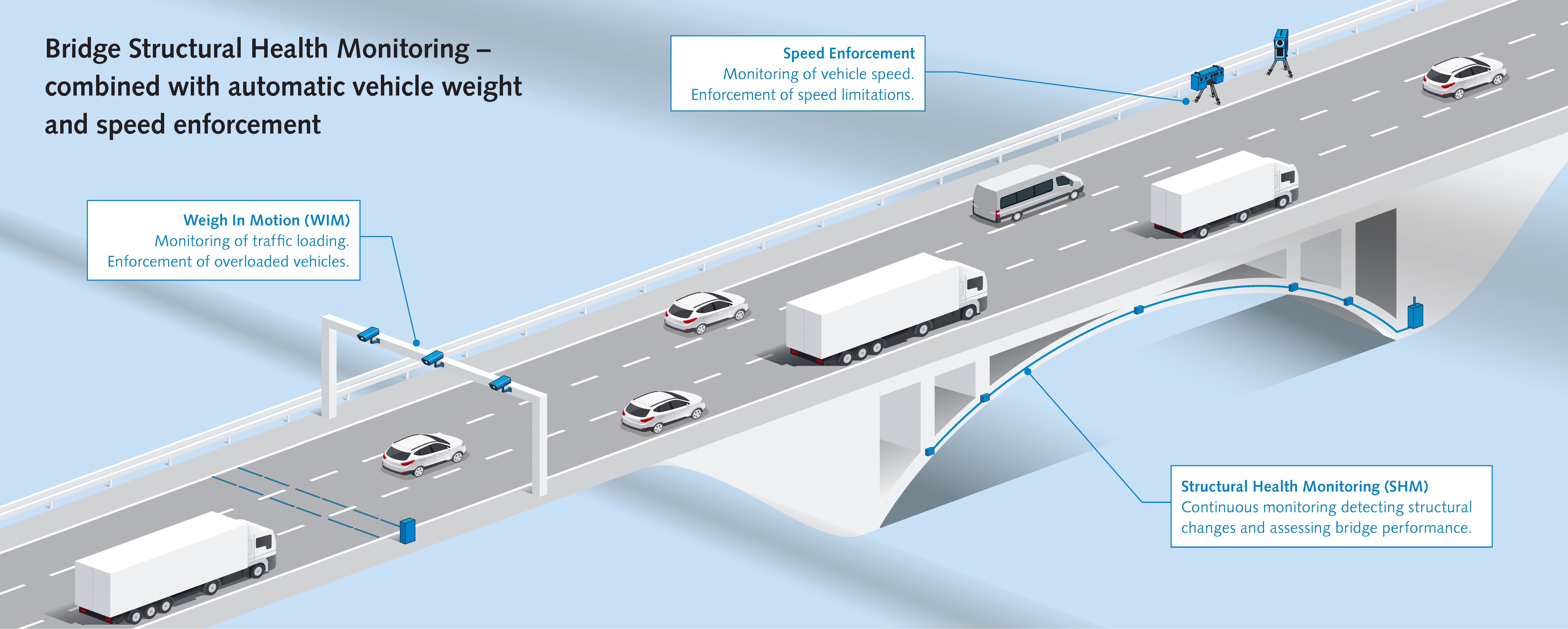
Artificial intelligence algorithms analyze the incoming data to detect anomalies. The system compares current readings against historical baselines and structural models. This processing identifies subtle changes in load distribution or material fatigue that human inspectors might miss during routine checks.

When the AI detects a deviation beyond safe thresholds, it generates a specific alert. Unlike generic maintenance schedules, these alerts pinpoint the exact location and nature of the issue. This precision allows crews to target repairs exactly where needed, reducing unnecessary traffic disruptions and labor costs.

Maintenance teams use the AI’s diagnostic report to plan interventions. They prioritize repairs based on severity and projected lifespan extension. This method ensures that limited public funds are spent on the most critical structural needs, extending the bridge’s service life significantly.
The Federal Highway Administration’s Bridge Health Monitoring Tool, enabled by condition-based platforms, demonstrates this shift. Agencies using these systems report fewer emergency closures and more predictable budgeting. The data shows that proactive care is far more cost-effective than reactive fixes after damage occurs.
Predictive maintenance is no longer experimental. It is the standard for managing aging infrastructure. By moving from reactive repairs to condition-based interventions, agencies can ensure long-term safety and efficiency.
Cost analysis and financial impact
The financial case for AI-driven bridge monitoring shifts from capital expenditure to long-term asset preservation. By 2026, the global market is projected to reach $1.4 billion, with forecasts suggesting it could nearly double to $3.1 billion by 2033. This growth reflects a broader industry pivot: agencies are prioritizing predictive maintenance over reactive emergency repairs to extend infrastructure lifespan.
Adopting these technologies reduces the volatility of maintenance budgets. Traditional inspection cycles often miss internal degradation until structural integrity is compromised, triggering costly emergency closures and repairs. AI and digital twin frameworks allow for continuous, real-time structural health monitoring. By 2026, approximately 15% of newly instrumented bridges globally will incorporate these digital twins, a figure expected to rise to over 45% by 2034. This shift enables agencies to allocate funds precisely where needed, rather than on blanket replacement schedules.
The economic impact extends beyond repair savings. Early detection of issues like corrosion or fatigue cracking prevents secondary damage that often doubles repair costs. For investors and infrastructure funds, this translates to more stable asset valuations and reduced liability risks. The market growth itself signals confidence in the ROI of these systems, as agencies recognize that the cost of implementation is significantly lower than the cumulative cost of deferred maintenance and catastrophic failure.
Bridging the gap between legacy systems and AI
Integrating artificial intelligence into bridge infrastructure monitoring is less about installing new software and more about untangling decades of fragmented data. Most transportation agencies operate on legacy systems that were never designed to speak to modern machine learning models. The result is a disjointed ecosystem where sensor data, inspection reports, and maintenance logs sit in silos, making it difficult for AI algorithms to find the patterns they need to predict failures accurately.
Data standardization is the first major hurdle. Without a unified format, AI models struggle to reconcile different types of information. For instance, a visual inspection report from 2015 might use different terminology than a digital sensor reading from 2024. Agencies must invest in data cleaning and normalization pipelines before any advanced analytics can take hold. This process is often more time-consuming and costly than the AI implementation itself, requiring a shift in how agencies view data as a strategic asset rather than a byproduct of inspection.
The National Academies of Sciences, Engineering, and Medicine has highlighted the importance of long-term, consistent data collection in their review of the Long-Term Bridge Performance (LTBP) program. The LTBP program’s 20+ year effort to monitor a nationally representative sample of bridges underscores a critical lesson: AI is only as good as the historical data it ingests. Short-term or inconsistent datasets lead to unreliable predictions, which can have catastrophic consequences in high-stakes infrastructure management.
Decision-makers also face the challenge of trust. An AI model might flag a bridge for immediate repair, but if the reasoning is opaque, agency engineers may hesitate to act on it. Explainable AI (XAI) techniques are becoming essential to bridge this trust gap. By providing clear, interpretable reasons for AI recommendations, agencies can move from skeptical observers to active participants in the monitoring process. This transparency is vital for ensuring that AI serves as a tool for informed decision-making rather than a black box that generates unverified alerts.
No comments yet. Be the first to share your thoughts!